FROM THE MAKERS OF HRDCOPY
The Analog Backup
19 chapters on why your family's most critical information should never depend on a battery.
19
Chapters
50,000+
Words
4
Free Previews
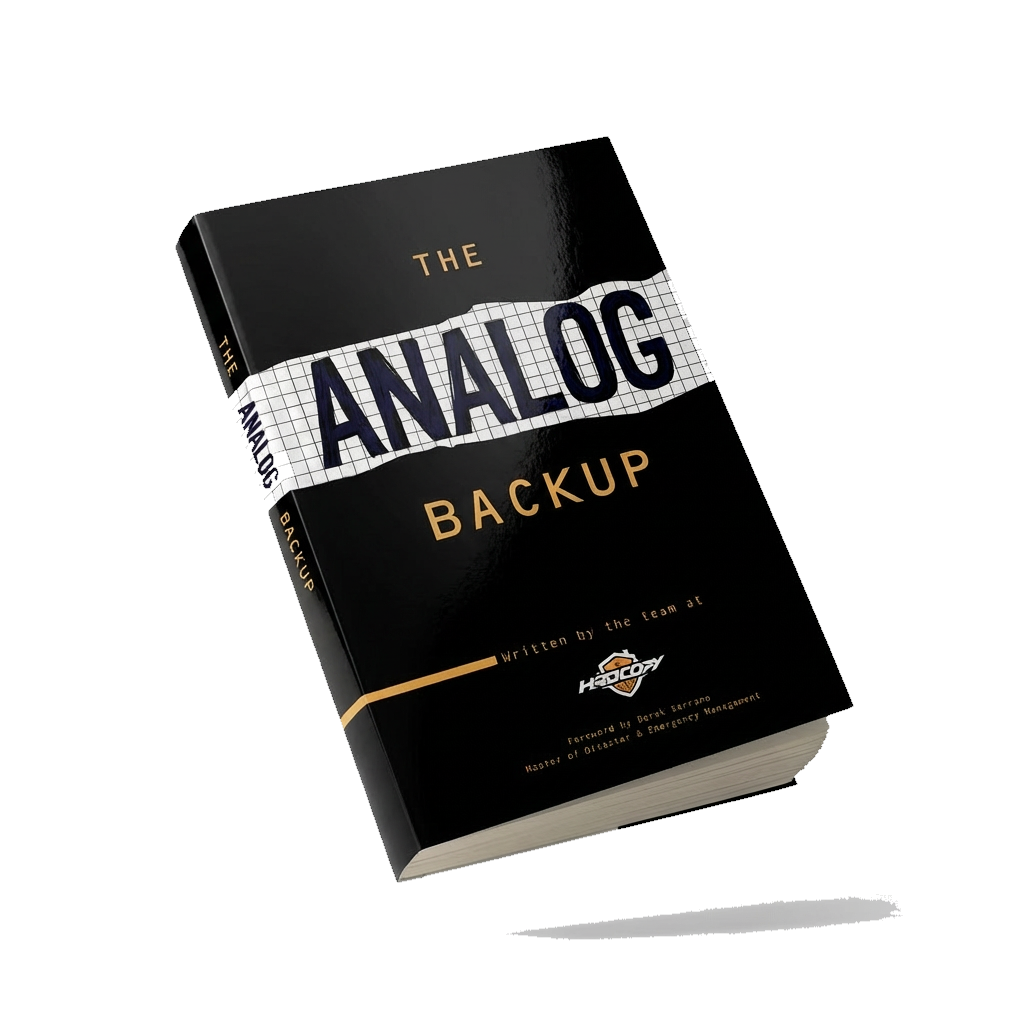
ABOUT THE BOOK
Your family's most critical information shouldn't depend on a battery.
We store everything in the cloud. Medical records, insurance policies, emergency contacts, passwords, medication lists, utility shut-off procedures. All of it lives behind a screen that needs Wi-Fi and a charged battery to work.
Then the power goes out. The phone dies. And everything you need is locked behind glass.
The Analog Backup is a 19-chapter guide to extracting your household's critical operating data from the cloud and putting it on paper. No gear lists. No bunkers. No doomsday prepping. Just the system that keeps your family running when the screens go dark.
"Paper is the most advanced data storage technology ever invented."
The book follows one question to its logical end: “If I am not there, and the internet is not working, does my household function?”
If the answer is no, you don't have a resilient home. You have a fragile one. And this book will show you how to fix that — chapter by chapter, system by system.
19 CHAPTERS
Table of Contents
Read 4 chapters free — no email required.
I want you to imagine a scenario. It is a Tuesday night. You and your partner are going out for dinner — your first date night in months. Maybe longer.
You have hired a babysitter. Let's say it's your neighbor's oldest daughter. She's seventeen, responsible, CPR-certified. You've used her a dozen times. You pay her, you order the pizza, you stick a note on the fridge with the Wi-Fi password, and you hand her your phone number.
"Call us if you need anything," you say.
Then you walk out the door.
Two hours later, a drunk driver hits a utility pole three blocks away. A transformer blows. Your neighborhood goes pitch black.
The cell tower down the road — the one you've never thought about, the one hidden behind the strip mall — loses its connection to the power grid. Its backup battery, designed to last four hours on a good day, starts draining.
Your house is dark. The internet is dead. The "Smart Home" security system is beeping a low-battery warning — a thin, persistent chirp that sounds like a smoke detector with a dying soul.
The babysitter stands in the hallway. She tries the light switch. Nothing. She pulls out her phone. The screen casts a blue glow across the ceiling. No Service.
She tries to text you. The message hangs. A gray bar inches across the screen and stops. Not Delivered.
From the bedroom down the hall, your six-year-old calls out: "Why is it dark?"
The babysitter walks toward the voice. She doesn't know where the flashlights are. She doesn't know where the candles are. She doesn't know where the first-aid kit is, because you never told her — why would you? You're always there.
She doesn't know your pediatrician's name. She doesn't know if your daughter is allergic to anything. She doesn't know the code to the lockbox on the front door, or which neighbor has a spare key, or that the breaker box is behind the mirror in the laundry room.
She has your phone number. But the phone doesn't work.
Your daughter asks if the pizza is still coming. The babysitter says yes, even though the delivery app won't load and she doesn't have the restaurant's phone number memorized. Nobody does anymore.
Then your four-year-old trips on a toy in the dark hallway and starts screaming. His lip is bleeding. The babysitter holds him, tries to calm him down. She needs the first-aid kit. She opens three cabinets before she finds one — and when she does, she realizes she doesn't know if your son is allergic to the adhesive in standard bandages. She doesn't know because you've never had a reason to tell her.
She thinks about driving him to urgent care. But which one? She doesn't know the address. She could Google it — except she can't Google anything. And even if she could drive there, she doesn't have proof of his insurance. She doesn't have his date of birth memorized. She doesn't have a signed authorization form giving her permission to approve medical treatment.
She is seventeen years old, standing in a dark kitchen, holding a crying child who isn't hers, with no way to reach you, no way to reach a doctor, and no information to give anyone even if she could.
Inside that house are the most important people in your life. And the person watching them is holding a rectangle of black glass, surrounded by answers she can't access.
This is the Babysitter Protocol.
It is the ultimate stress test for your household. Not your house — your household. The living, breathing system of people, information, and infrastructure that keeps your family functioning.
Ask yourself one question:
"If I am not there, and the internet is not working, does my household function?"
If the answer is no, you do not have a resilient home. You have a fragile one. You have built a life that requires your physical presence and a working internet connection to survive.
The Indispensable Flaw
We wear our busyness like a badge of honor. "I handle the bills." "I know where the breaker box is." "I'm the only one who knows the alarm code."
We think being indispensable makes us good providers.
In reality, being indispensable makes you a single point of failure.
You know the gate code to the backyard. Your spouse doesn't. You know which breaker controls the sump pump. Nobody else does. You know the name of the plumber who fixed the water heater last year — it's in a text thread on your phone, three months back, buried under takeout orders and group chats.
If you are incapacitated — if you are stuck at work, in the hospital, or on a plane somewhere over Kansas without Wi-Fi — and a crisis hits your home, everything you know is useless. Not because you forgot. Because your knowledge is trapped inside your head, and your head isn't there.
This book is not about building a bunker. It is not about hoarding fifty pounds of rice or buying a gas mask.
This book is about Extraction.
We are going to extract the critical operating data of your life — your medical history, your financial access, your infrastructure maps, your emergency contacts — from the cloud and from your brain. We are going to put it into a physical, durable format that anyone can read.
We are going to build a Hard Copy.
Think of it as the operating manual for your household. Not a prepper's fantasy. Not a survival guide for the zombie apocalypse. A practical, organized document that lets anyone — your spouse, a babysitter, a neighbor, a paramedic — step in and keep things running when you can't.
The Hard Copy contains the answers to the questions that matter at 2:00 AM when the lights die: Who do we call? Where is the shut-off valve? What medication does he take? What's the insurance policy number?
It doesn't need Wi-Fi. It doesn't need a password. It doesn't need a charged battery. It just needs to be on the counter.
Over the following chapters, we are going to perform a resilience audit on your entire life. We are going to hunt down every piece of critical data that is currently floating in the cloud or trapped in your skull, and we are going to bring it down to earth — into your hands, onto paper, where no server outage or cracked screen can touch it.
So that the next time you walk out the door for date night, you aren't just leaving a phone number. You are pointing to a black book on the counter and saying:
"If anything happens, the answer is in there."
You are the CEO of your household. You manage the logistics, the finances, the healthcare, and the security. You run a small, complex organization every single day.
It's time to write the company manual.
In the next chapter, you'll meet a family in Austin, Texas, who learned what happens when the CEO has no manual — and the grid goes dark in the middle of February. Their story will change how you think about every device in your home.
Let's get to work.
It happened on a Tuesday in February 2021.
For David and Elena Miller, living in a suburb of Austin, Texas, the day started like any other. They were a modern family. They had solar panels on the roof. They had a stocked pantry full of organic groceries delivered by an app. They had an electric vehicle in the garage and the latest iPhones in their pockets. Their Nest thermostat kept the house at a steady 72 degrees. Their Ring doorbell watched the porch. Their smart locks auto-engaged at 10:00 PM.
They felt safe because they were surrounded by technology.
Then, at 2:17 AM, the silence woke them up.
The low hum of the refrigerator — a sound you never consciously hear until it's gone — had stopped. The smart streetlights outside the window went dark. The Wi-Fi router in the hallway, usually a blinking constellation of green LEDs, was dead.
David reached for his phone. Fourteen percent battery. He tried to open the power company's app to report the outage. A spinning wheel appeared on the screen.
Loading... Loading... Connection Failed.
"It's just a blown transformer," he told Elena. "It'll be back in an hour."
It wasn't back in an hour.
By 6:00 AM, the temperature inside the house had dropped to 48 degrees. The Nest thermostat was a lifeless black circle on the wall. It couldn't call for heat because it had no power, and even if it did, the gas furnace required an electric spark to ignite.
Their seven-year-old, Lily, padded into the bedroom wrapped in a comforter, shivering. "Daddy, the heater's not working." Behind her, their four-year-old, Max, stood in the doorway in his pajamas, holding a stuffed dinosaur, not saying a word. He didn't have the vocabulary for what he was feeling, but he knew something was wrong because his parents looked scared.
Elena pulled both kids into the bed. She checked her phone for news. No signal. She tried the landline — they didn't have one. She tried to call her mother in San Antonio from the bathroom, holding the phone against the window, tilting it toward the sky like a prayer.
Nothing.
By 8:00 AM, they decided to leave. "Let's go to your mom's house in San Antonio," Elena said.
They went to the garage. David hit the button to open the heavy, double-wide garage door. Nothing happened. The electric motor was dead. He reached for the emergency release cord — the red handle dangling from the track. It was jammed. Corroded. It hadn't been tested in the four years they'd lived there, and now it refused to give. Their $60,000 electric vehicle — their escape pod — was trapped behind a 300-pound wall of steel they couldn't lift.
David went back inside to call a tow truck. He looked at his phone. No Service. The local cell towers, overwhelmed by a million panicked residents and running on depleted backup batteries, had collapsed.
He sat down at his kitchen island. He held his phone — a rectangle of black glass that contained his bank accounts, his maps, his medical history, his contacts, and his family photos.
Without the grid, it was just a rock.
He was staring into a black mirror, and for the first time in his adult life, he realized the terrifying truth: he wasn't just offline. He was helpless. He was sitting in a $400,000 smart home that had become profoundly, irreversibly stupid.
Elena stood in the kitchen doorway. "Do you know your mom's number?" she asked. Not the contact card. The number.
David opened his mouth. Nothing came out. He hadn't dialed a phone number from memory in over a decade. He didn't know his mother's number. He didn't know Elena's number. He didn't know the pediatrician's number, the insurance company's number, or the number for the local fire department — the real ten-digit number, not 911, which was jammed with a hundred thousand callers.
Every number he had ever needed was stored in a device that was almost dead. Every map, every account, every record. His life was in there, and it was draining at a rate of one percent every forty minutes.
The Millers survived the freeze. It took three days. They burned firewood from a neighbor's yard in the outdoor fire pit and huddled around it wearing every piece of clothing they owned. They melted snow in a stockpot for drinking water. They never made it to San Antonio.
When the power finally came back, David sat at his kitchen island again — the same spot — and made a decision. He would never be that helpless again.
But the damage wasn't just physical. It was psychological. For months afterward, every time the lights flickered during a storm, David's chest tightened. Elena started keeping a bag of groceries in the trunk of her car, "just in case." The kids asked questions they hadn't asked before: "What if the power goes out again?" "Will we be okay?"
The freeze didn't destroy the Miller house. But it destroyed something more important: the family's assumption that they were safe.
Here's the thing about the Millers: they weren't unprepared. They were modern. And "modern" turned out to be a synonym for "fragile."
The Illusion of Safety
We live in an age of magical convenience. We have outsourced our memory, our navigation, and our survival to the Cloud.
We assume that information is like air — always there, always free, always accessible.
We scan our passports to Google Drive and call it a "backup." We save our emergency contacts in our "Favorites" list and call it "connection." We rely on banking apps to move money and call it "security." We store our children's vaccination records in an app. We keep our insurance policy in an email folder. We trust a six-digit code and a thumbprint to guard everything we own.
But we have confused convenience with safety.
Convenience is being able to order a pizza with a voice command. Safety is knowing that if the voice assistant dies, you can still feed your family.
The story of the Millers isn't a doomsday fantasy. It's not a movie plot. It happens every time a hurricane hits Florida, a wildfire sweeps through Maui, or a cyberattack shuts down a hospital system. In 2023, a ransomware attack on a hospital chain in multiple states forced doctors to write prescriptions by hand — and some of them couldn't, because they'd never had to read a patient's chart on paper. The digital system was the only system. When it died, so did the workflow.
We have built our entire lives on a foundation that requires three things to function perfectly, 100% of the time:
- Electricity to power the device.
- Connectivity to reach the data.
- Biometrics (your face or fingerprint) to unlock the gate.
If any single link in that chain breaks, your "safety net" evaporates. Not gradually. Instantly.
And the failure doesn't announce itself with a warning. It announces itself with silence. The hum stops. The screen goes dark. And you are standing in your own home, realizing you don't know the first thing about how to operate it without electricity.
The First 15 Minutes
The moment the grid fails, a clock starts ticking. I call this the "Panic Gap."
It is that sickening window of time between the lights going out and you realizing you don't know what to do. Your pulse spikes. Your mouth goes dry. And the first thing you reach for — your phone — is the one thing that can't help you.
Ask yourself these four questions right now:
- The Comm Check: If your phone died right this second, could you recite your spouse's phone number? Not "Siri, call wife." The actual ten digits.
- The Medical Check: If you had to evacuate to a shelter, do you have a physical copy of your child's prescription to show a pharmacist who can't access their computer?
- The Asset Check: If your house burned down, do you have the deed and insurance policy number in a fireproof bag, or are they "somewhere on the laptop" that is currently melting?
- The Access Check: If you were knocked unconscious, could your spouse unlock your phone to access the bank accounts and pay the mortgage?
If you answered "No" to any of these, you are not resilient. You are David Miller, sitting at the kitchen island, staring at a rock.
The Analog Backup
There is a solution to this fragility. It is so old, so unglamorous, and so low-tech that it feels almost radical in 2025.
You need paper.
Paper is the most advanced data storage technology ever invented.
- Infinite Battery Life: It never needs to be charged.
- Zero Latency: It creates an instant connection with your eye.
- Universal Compatibility: It requires no password, no FaceID, and no software update.
- Durability: If you use the right materials (which we will cover in Chapter 16), it is drop-proof, hack-proof, and smudge-proof.
- EMP-Proof: No electromagnetic pulse, solar flare, or ransomware attack can corrupt a piece of paper. It is immune to every digital threat that exists.
Paper doesn't crash. Paper doesn't need a two-factor authentication code. Paper doesn't tell you that your session has expired and ask you to verify your identity by clicking on pictures of traffic lights.
You are the CEO of your household, but all your company records are stored on a server you don't own, accessible only through a device that runs on a battery that lasts fourteen hours. No real CEO would operate that way. No competent executive would store the only copy of their operating procedures in a system that fails when the power goes out.
In the high-stakes environment of a true emergency, the most sophisticated tool you can possess is a Hard Copy — a physical, printed manual that contains everything your household needs to function when the screens go dark.
This book is your guide to building one. Over the following chapters, we are going to perform a resilience audit on your life. We are going to hunt down the critical data that is currently trapped in the cloud, and we are going to bring it back down to earth, into your hands, where it belongs.
We are going to take you from digitally fragile to analog secure.
And we're going to do it before the lights go out.
But to do that, you first need to understand exactly where your information lives right now — and why the place you've been trusting with your life is a lot more fragile than its name suggests. Because "the cloud" sounds like it's floating above the chaos. Safe. Permanent. Untouchable.
It isn't. It never was. And in the next chapter, we'll show you exactly what happens when the cloud gets wet.
Rachel Townsend was forty-three years old when her husband Mark had a heart attack in the driveway.
It was a Saturday morning. He was carrying mulch from the truck to the flower beds. She heard the bags hit the concrete before she heard him fall. By the time the ambulance arrived, he was unconscious. By Sunday evening, he was gone.
The grief was immediate and consuming. But within forty-eight hours, a second crisis landed on top of the first, and this one didn't come with condolence cards.
Rachel needed to pay the mortgage. Mark had handled it. She didn't know which bank held the loan. She didn't know the login. She didn't know which email address he'd used to set up the account. He had three.
She picked up his phone. It stared back at her. FaceID. It needed Mark's face, and Mark was at the funeral home.
She tried his laptop. A password field blinked at her. She guessed his birthday, their anniversary, the dog's name, the name of his college roommate. Nothing worked. After six attempts, the system locked her out for twenty-four hours.
She called the bank. They asked for the account number. She didn't have it. They asked for the last four of his Social Security number. She knew that one, thank God, but they said they couldn't discuss the account without a death certificate, which the county wouldn't issue for ten business days.
She called the life insurance company. Same wall. Policy number required. She searched Mark's email, but his email was behind a two-factor authentication code that went to his locked phone. The phone that needed his face.
For three weeks, Rachel Townsend — a woman with a paid-off house, a retirement account, and a $500,000 life insurance policy — could not access a single dollar of her own family's money. She borrowed $2,000 from her sister to cover groceries and her daughter's daycare. She paid the electric bill late for the first time in her life, because the autopay was tied to a credit card in Mark's name, and the credit card company had already frozen the account.
She told me later: "He did everything right. He had the insurance. He had the savings. He had it all set up. But he set it up for himself, and when he was gone, it was like the money didn't exist."
We have built the most sophisticated security systems in human history. They are designed to keep everyone out. Including the people who need in the most.
The Mythology of the Cloud
If you ask a teenager where their photos are, they will point to the sky. "They're in the cloud," they say.
Marketing departments have done a brilliant job of selling us a metaphor. We imagine "The Cloud" as this ethereal, omnipresent mist, a magical bank vault in the atmosphere where our memories, money, and identities float safely above the chaos of earth.
But the cloud is not a cloud.
The cloud is a windowless, concrete warehouse in Ashburn, Virginia, humming with the sound of fifty thousand industrial air conditioners. It is a bundle of fiber-optic cables sitting on the bottom of the Atlantic Ocean, getting gnawed on by sharks. It is a server farm in Texas that relies on the same power grid that failed David and Elena Miller.
The cloud is just someone else's computer.
And just like your computer, it can crash, lose power, and get disconnected. When we rely on the cloud for our survival, we are making a dangerous assumption: that the complex, fragile infrastructure of the modern world will never blink.
But it blinks all the time.
The Chain of Dependency
To access a single digital document (say, your homeowner's insurance policy PDF), a miracle of engineering has to happen. A chain of six distinct links must hold together perfectly:
- The Server: The insurance company's server must have power and internet.
- The ISP: The massive internet backbone providers (like AT&T or Comcast) must be operational.
- The Local Node: The cell tower or cable box in your specific neighborhood must have electricity.
- The Hardware: Your phone or laptop must be functional, not wet, cracked, or overheated.
- The Power Source: Your device must have a charged battery.
- The Key: You must remember your password or have a functional biometric (fingerprint/face).
If any single link in this chain breaks, the document disappears. It doesn't matter if the other five links are perfect.
If the server is fine but your battery is dead, you have nothing. If your battery is full but the cell tower is overloaded, you have nothing. If you have service but forgot the password because you're in shock, you have nothing.
A physical piece of paper has a chain of dependency of one: Do you have the paper?
The "Last Mile" Problem
Let's assume the internet itself is fine. Google is up. Apple is up. The servers are humming.
The problem usually isn't the cloud; it's the "Last Mile." The connection between the grid and your hand.
In every major disaster of the last decade, from Hurricane Sandy to the wildfires in Maui, the first thing to fail is the Last Mile. Cell towers have backup batteries, but they are designed to last hours, not days. Once those batteries drain, the signal goes dark.
I spoke with a family in California who evacuated during a wildfire. They had "everything" on their phones. Photos of their passports, their insurance, their evacuation routes.
But as they sat in gridlock traffic, surrounded by smoke, thousands of other people were hitting the same cell tower to download maps and check the news. The network collapsed under the load. Their phones showed four bars of signal but couldn't load a single webpage.
They were holding $1,000 devices that had been rendered into paperweights by network congestion. They couldn't prove who they were. They couldn't access their bank accounts. They couldn't even show the shelter intake volunteer a photo of their homeowner's insurance card. They were digital refugees, people with assets, identity, and resources who could access none of it because the last mile had gone dark.
The "Bus Factor"
There is a darker vulnerability we rarely talk about: the one Rachel Townsend discovered.
Digital security is designed to keep people out. FaceID, fingerprints, two-factor authentication, complex passwords. These are walls built to protect your privacy.
But in an emergency, those walls become a cage.
Imagine you are the "Chief Technology Officer" of your household. You manage the bills, the insurance, the passwords. Now imagine you are knocked unconscious in a car accident. Or you are in the hospital on a ventilator. Or, like Mark Townsend, you don't come home.
Your spouse needs to access the life insurance policy. They need to pay the mortgage. They need to find the deed to the house.
They pick up your phone. Locked. They try your laptop. Password required. They try to reset the password, but the 2FA code goes to your locked phone.
I call this the "Bus Factor": if you get hit by a bus, does your household's operating system crash?
By securing your digital life, you have inadvertently locked your family out of their own survival. The irony is vicious: the more responsible you are with your cybersecurity, the more dangerous your absence becomes.
You Are Renting Your Life
When you store your life digitally, you are a tenant. You are renting access to your own data from Apple, Google, and Verizon. You are paying them with a monthly subscription and your privacy, and in exchange, they promise to let you see your photos and documents most of the time.
But when the power goes out, the landlord locks the doors. When you die, the landlord changes the locks.
A Hard Copy is different. It is ownership. When you print a document and put it in a binder, you have taken it off the grid. You own it the way you own a hammer or a set of house keys: completely, permanently, without a terms-of-service agreement.
It doesn't require a subscription. It doesn't need a software update. It doesn't care if the server in Virginia is on fire.
Why I Built This
I wish I could tell you I figured all of this out through careful research. The truth is, I figured it out the way most people do: by watching fire crawl toward my house.
We live in Southern Oregon. Every summer, the trees dry out and the sky turns into a coin flip. Lightning strikes start fires. Careless humans start fires. And when the wind kicks up, a manageable situation becomes an unmanageable one in about fifteen minutes.
Last year the Neil Creek Fire started less than a mile from our home.
I stood in the yard and watched attack planes drop retardant over the ridge. Pairs of helicopters worked the fire line all day, every day, for weeks. The sound of rotors became background noise. We organized pizza deliveries from every shop in town to keep the firefighters fed. We checked on neighbors. We tried to be useful. But mostly, we waited.
For three straight nights, my wife and I went to bed with our phones on the pillow, evacuation alerts armed. Our vehicles were packed: the kids' things, the animals, sleeping bags, food, water, everything we'd need to get to our rally point outside the zone. The firefighters held the lines. We were blessed. A lot of people aren't.
But here's what I didn't expect: the stress of pulling it all together.
The fire moved fast. And that first night, I was up until four in the morning digging through filing cabinets and desk drawers, hunting for passports, insurance declarations, the deed to the house, vaccination records for the dogs. I was copying account numbers onto a legal pad with a Sharpie because my hands were shaking too much for a pen. My wife was loading photo albums into the truck while I argued with a scanner that wouldn't connect to WiFi, because of course it wouldn't.
I thought I was prepared. I was the guy who had a go-bag. I was the guy who'd read the FEMA guides. I was the guy who told other people to have a plan.
I was not prepared.
Everything I needed was scattered across four devices, three email accounts, a filing cabinet I hadn't opened in two years, and a Google Drive folder called "Important Stuff" that contained exactly one document: a scan of my son's birth certificate from 2019, slightly crooked.
After the fire was contained, after the helicopters finally went quiet, I sat down at the kitchen table and started writing things down. All of them. Insurance policy numbers. Pediatrician's after-hours line. The location of the gas shutoff. Our kids' allergies. The neighbor's cell number. Everything that mattered, on paper, in one place.
That legal pad became a binder. The binder became a system. The system became HRDCOPY.
I didn't build it because I'm a prepper. I built it because I'm a dad who almost had to evacuate his family at two in the morning and realized that every critical piece of information he owned was locked behind a screen that could die, break, or lose signal at the worst possible moment.
The best time to build your manual is when you're rich on time and low on stress. Not at four in the morning with smoke on the horizon.
[Worksheet 2] The Digital Dependency Audit
Before we move forward, let's measure how exposed you really are. For each item below, answer honestly.
Account 1: Primary Bank
- Can you access this without your phone? [ ] Yes [ ] No
- Does your spouse/partner know the login? [ ] Yes [ ] No
- Do you have the account number written down anywhere physical? [ ] Yes [ ] No
Account 2: Health Insurance Portal
- Can you access this without your phone? [ ] Yes [ ] No
- Does your spouse/partner know the login? [ ] Yes [ ] No
- Do you have the policy number and claims phone number written down? [ ] Yes [ ] No
Account 3: Homeowner's / Renter's Insurance
- Can you access this without your phone? [ ] Yes [ ] No
- Does anyone else in your household know the policy number? [ ] Yes [ ] No
- Do you have the Declaration Page printed? [ ] Yes [ ] No
Account 4: Email (Primary)
- Can you access this without your phone for 2FA? [ ] Yes [ ] No
- Does your spouse know the password? [ ] Yes [ ] No
- Could someone access your critical accounts if this email was locked? [ ] Yes [ ] No
Account 5: Power / Utility Company
- Can you report an outage without the app? [ ] Yes [ ] No
- Do you have the 10-digit customer service number written down? [ ] Yes [ ] No
Score: Count your "No" answers.
- 0–3: You're ahead of most people, but you still have gaps.
- 4–7: You are Rachel Townsend. One bad day separates you from your own life.
- 8+: Your entire existence is one dead battery away from disappearing.
But before we start building the solution, we need to talk about why you haven't done this yet. The answer isn't laziness. It isn't ignorance. It's something more insidious: it's identity. Because the biggest obstacle between you and a resilient household isn't technology.
It's the guy in the basement with the tactical vest. And in the next chapter, we're going to kill him.
The ice storm hit the subdivision at 3:00 AM on a Thursday in January.
By sunrise, the roads were glass. Tree branches snapped under the weight of the ice and draped across power lines like garland. Half the neighborhood lost power. The other half lost it by noon.
Two houses on Sycamore Lane handled it differently.
In House A lived Gary Pruitt. Gary was ready. He had been ready for years. He had a generator in the garage, a chest freezer full of vacuum-sealed meat in the basement, six months of MREs in labeled bins, a ham radio setup in the spare bedroom, and a gun safe with enough ammunition to supply a small militia. He had tactical flashlights, a water filtration system rated for creek water, and night vision goggles he'd bought from a surplus site. His neighbors called him "Doomsday Gary," and he wore the nickname like a badge.
When the power went out, Gary fired up his generator. It ran for two hours and then died. He'd stored gasoline in the garage for eight months without adding fuel stabilizer. The gas had gone sour. The generator choked on it like a bad drink.
He went to his freezer full of meat. The chest freezer had been running on grid power. Without it, the clock was ticking on two hundred dollars' worth of vacuum-sealed steaks. He needed ice. The roads were impassable. The stores were closed.
He tried his ham radio. He hadn't used it since he set it up. The antenna connector had corroded. He got static.
His wife, Linda, asked him a question he couldn't answer: "Where is the homeowner's insurance policy? If the pipes burst, we need the policy number."
Gary went to his office. He opened drawers. He moved stacks of tactical magazines and old ammo catalogs. He found a tax return from 2019. He found a receipt for the night vision goggles. He did not find the insurance policy. It was somewhere on his laptop, in an email from an agent whose name he couldn't remember, behind a password he'd written on a sticky note that had fallen behind the desk three years ago.
Gary had prepared for the end of the world. He had not prepared for a Tuesday.
Across the street, in House B, lived Tom and Angela Park. Tom was not a prepper. Tom was an accountant. He drove a Camry. He owned zero tactical knives.
But three months earlier, after his buddy's basement flooded and the guy couldn't find his insurance paperwork, Tom had spent a Sunday afternoon putting a binder together. Nothing fancy. He printed the insurance declaration pages, wrote down the phone numbers for the utilities, taped a photo of the water shut-off valve inside the front cover, and slipped three hundred dollars in twenties into an envelope in the back.
When the power went out, Tom got the flashlight from the kitchen counter — the one he'd put there specifically for this purpose. He found the utility company's phone number in the binder and reported the outage from his cell phone before the towers got jammed. He pulled the binder off the shelf and checked: the pipes hadn't burst, but if they did, the insurance policy number was right there on page four. He gave Angela the number for the plumber, just in case.
Then he made his kids hot chocolate on the gas stove — the one that didn't need electricity to light — told them it was an indoor camping adventure, and went back to bed. Angela checked on the kids once, saw them playing cards by flashlight, and fell asleep reading a book.
Across the street, Gary was on his knees in the garage, pouring sour gasoline out of his generator and swearing.
The guy with the night vision goggles couldn't find his insurance policy. The guy with the kitchen binder never missed a beat. Preparation is not a costume. It's a system.
The Prepper Problem
If I asked you to picture a "prepper," you'd probably see Gary. The surplus fatigues. The basement stockpile. The topographical map pinned to the wall. The guy who is waiting for the government to collapse so he can finally say, "I told you so."
That guy has done a terrible job of branding safety.
Because of him, most normal, well-adjusted people are afraid to prepare for anything. We don't want to be associated with the fringe. We don't want our neighbors to see us carrying a case of water bottles into the house and start whispering. So we swing to the opposite extreme: Hyper-Complacency.
We do nothing. We rely entirely on "Just-in-Time" delivery for our food, "One-Click" access for our data, and "Always-On" connectivity for our communication. We act as if the systems that support our lives are invincible, simply because acknowledging they aren't makes us feel like that guy in the basement.
This is the great paradox of modern preparedness. The people who care too much look crazy. And the people who look normal don't care at all. The preppers are stigmatized. The complacent are celebrated. And the vast middle ground — the space where reasonable adults take reasonable precautions — is almost completely empty.
But there is a middle ground. It's called Resilience.
Resilience Is Not Prepping
Prepping is about fear. Resilience is about continuity.
Prepping is often rooted in fantasy. It focuses on surviving the apocalypse — a scenario that is statistically unlikely to happen in our lifetime. It is isolating, expensive, and obsessive.
Resilience is rooted in reality. It focuses on surviving Tuesday — the boring, common disruptions that happen every year. Storms. Power outages. Cyberattacks. Job loss. A pipe that bursts at 2:00 AM. The stuff that doesn't make the national news but absolutely ruins your week.
Here is the difference:
- Prepping is buying a gas mask for a nuclear war that might never happen. Resilience is having a printed copy of your insurance policy for the storm that happens every year.
- Prepping is burying gold bars in the backyard. Resilience is keeping $500 in small bills in a fireproof bag because credit card machines go down during power outages.
- Prepping is learning how to suture a wound. Resilience is having a list of your family's prescriptions and blood types so a paramedic doesn't make a fatal error.
*Resilience isn't about the end of the world. It's about the continuity of your world.*
The "Adulting" Argument
Let's reframe this entirely. Building a Hard Copy isn't an act of paranoia. It is an act of executive function.
If you run a business, you have backups. You have insurance. You have contingency plans. You wouldn't run a company without off-site data storage, yet most of us run our families with zero redundancy.
We are the CEOs of our households. We manage logistics (school pickups), finance (mortgages), healthcare (appointments), and security (locking the doors). But for some reason, when it comes to the data that keeps that organization running, we are remarkably unprofessional.
Ask yourself this business question: If Amazon Web Services goes down, does your family shut down?
If the answer is yes, you have a bad business model. And no self-respecting executive would keep running one.
You'd be fired. Or at least embarrassed at the board meeting.
Becoming resilient is the final step of adulting. You pay your taxes. You change the oil in your car. You go to the dentist. You should also have a physical backup of your life. It is not paranoid. It is not extreme. It is the sophisticated, responsible, boring-as-hell thing that competent adults do. Nobody calls you a "prepper" for having car insurance. Nobody calls you paranoid for wearing a seatbelt. A Hard Copy is the same category of grown-up behavior — it just hasn't been normalized yet.
The "Peace of Mind" Dividend
There is a hidden benefit to resilience that nobody talks about: anxiety reduction.
We live in a low-level state of digital anxiety. Every time the news shows a wildfire or a hurricane, a small voice in the back of your head says: What would we do? Every time your phone battery dips below ten percent, your pulse ticks up a notch. You worry about losing the phone. You worry about hacking. You worry about the vague, shapeless "what if."
I talked to a woman in North Carolina — a mother of three — who built her Hard Copy in September 2024. Six weeks later, Hurricane Helene hit her county. The power went out for four days. Cell service was spotty.
She told me: "I wasn't scared. I was annoyed, but I wasn't scared. I knew where the flashlights were. I knew the insurance number. I had the cash. My neighbor was knocking on doors asking everyone if they had their insurance policy number, and I just read mine off the page."
That's the dividend. When you hold a finished Hard Copy in your hands — when you feel the weight of it, the snap of the heavy, smudge-proof pages — something shifts. You realize you are no longer dependent on the battery icon in the top right corner of your screen.
You have decentralized your safety.
If the phone dies? Fine. You have the numbers. If the internet cuts out? Fine. You have the maps. If the cloud evaporates? Fine. You have the deeds and titles.
You are no longer a tenant of the digital world. You are an owner of your own reality. And that feeling — that quiet confidence — is worth more than any bunker.
The Mission
This brings us to the core philosophy of this book: Information is the most valuable asset in a crisis.
In a true emergency, you don't need fifty pounds of rice. You can go three weeks without food. You can go three days without water. But you cannot go three minutes without information.
Where is the meeting point? What is the policy number? What is the gate code? Who is the emergency contact? What medication does she take? Where is the water shut-off? What's the vet's number? Who has the spare key?
When the adrenaline spikes and the screen goes black, he who has the information wins.
Over the next few chapters, we are going to build your Hard Copy. We are going to treat it like a tactical manual for your life. We are going to ignore the zombies and focus on the documents. We are going to ignore the bunkers and focus on the binders.
We are going to build a system that works even when the world doesn't.
Tom Park didn't build a bunker. He built a binder. And when Tuesday came, the binder was enough.
“We have confused convenience with safety.”
“Without the grid, it was just a rock.”
“Resilience isn't about the end of the world. It's about the continuity of your world.”
FROM THE MAKERS OF
HRDCOPY
HRDCOPY is a guided interview that produces a print-ready household emergency manual. The Analog Backup is the philosophy behind it — the why before the how.
Read the book. Then build your own Hard Copy.
Don't wait for the lights to go out.
A nonfiction book about household resilience. 19 chapters. No gear lists, no bunkers — just the system that keeps your family running when the screens go dark.